

Rapid Production Streamlit App
Company:
 Santander Bank Poland
A mission-critical, client-facing Streamlit application built under very high time pressure.
Technologies Used
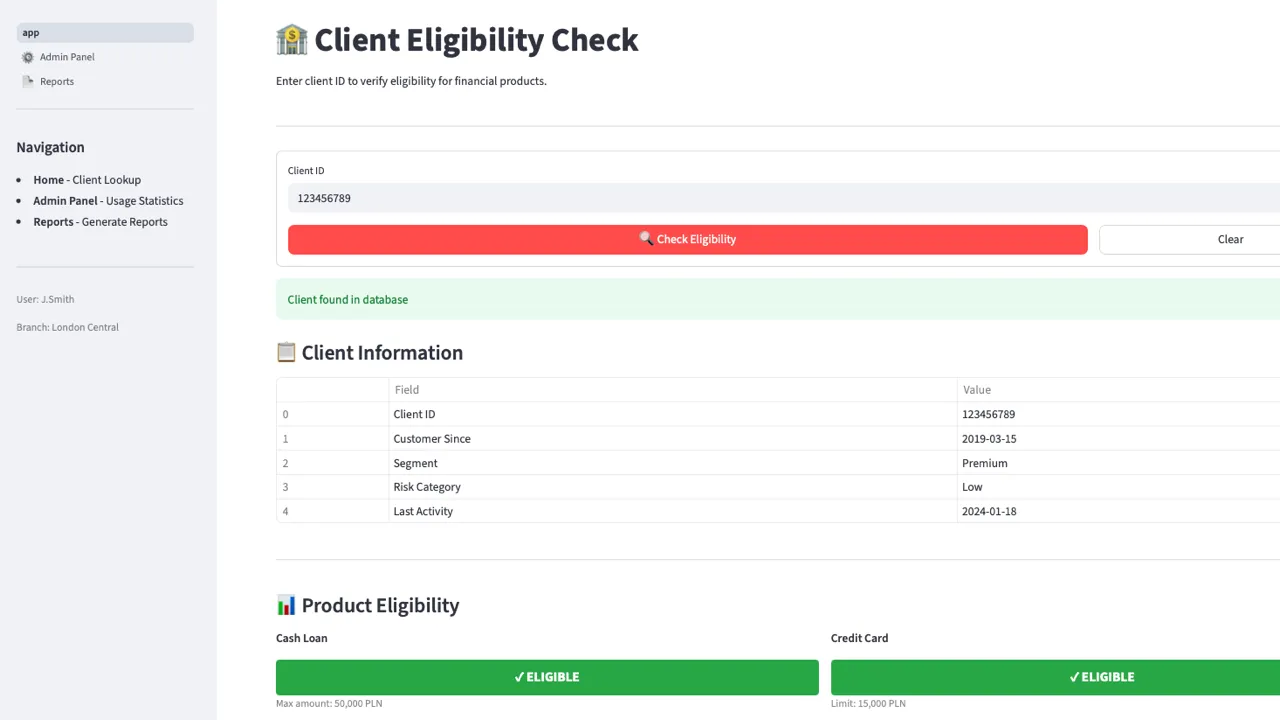
Due to NDAs, no real screenshots or code can be shown for corporate projects. Instead, mockup scripts were created to generate images resembling the original projects.
Problem Definition
If your work is project-based, it might happen that some of the projects will require you to operate in a very quick pace.
And one of such cases was when I was asked to develop an app for bank tellers to check clients’ eligibility for financial products.
Sounds simple, right? Just an interface and a database check. But there were complications:
- Business logic was still being finalized while we were building
- New database needed - the standard one was too slow
- Daily ETL process had to be established
- Production-grade deployment - previous Streamlit apps were non-critical; this one was client-facing
- Higher scale - dozens of concurrent users, potentially hundreds daily
And the app should have been ready yesterday. Or in the next 24 hours the latest.
Solution
Building a functional app in one day? With AI tools, maybe. But when you have to build it fully yourself?
Streamlit was the answer. Already established in the organization and known for rapid development, it was a natural choice.
And it turned out to be a good fit. The app was backend-heavy but UI-light - all the complex logic happened in database queries and Python code. The interface was simple: an input field and results display. No fancy interactivity, no complex session state. Just: enter ID → query → show result.
What We Built
Core Features
- Client ID input with validation
- Real-time eligibility checks via database queries
- Clear decision display - yes/no with relevant details
- Error handling for edge cases
Authentication & Compliance
- LDAP authentication - no separate accounts, just corporate credentials already used in the organization
- Usage logging - tracking who checked which client and when, saved to database for audit purposes
Administration
- Admin panel - not just usage logs, but also business logic rule maintenance. Control Analysts could edit some rules themselves without touching code.
Separately, we established a new database with a daily ETL process (my boss handled this part while I focused on Streamlit).
How It Went
After a few exhausting days (it stretched beyond 24 hours, of course), the application was deployed. And it worked:
- Hundreds of users handled without issues
- Dozens of concurrent sessions - Streamlit performed better than expected
- Zero critical failures after initial stabilization
- Successfully served its purpose
Impact
This was a proof point for Streamlit in production at a big organization. Previously considered just a prototyping tool, this project showed it can handle real load when the use case fits.
The app served as a temporary solution while a permanent system was being developed. Of course, “temporary” in enterprise often means “runs longer than expected” - and it held up.
Eventually it was replaced by a Vue app with better UI and additional features that would have been limited in Streamlit. But the Streamlit version was good enough for the start, and the Vue replacement didn’t have to be built under the same time pressure.
Professional Takeaways
- Streamlit can work in production - but only when the use case aligns with its strengths (backend-heavy, simple UI, limited state management)
- Deep framework knowledge enables rapid delivery - knowing Streamlit’s quirks and capabilities meant I could move fast without hitting unexpected walls
- Time pressure development is a different skill - it’s not just about coding fast, it’s about knowing what to simplify, what corners can be cut, and what absolutely cannot be compromised